
-
“St. Jude was responsible for her life-change”: Donor shares his mom’s story
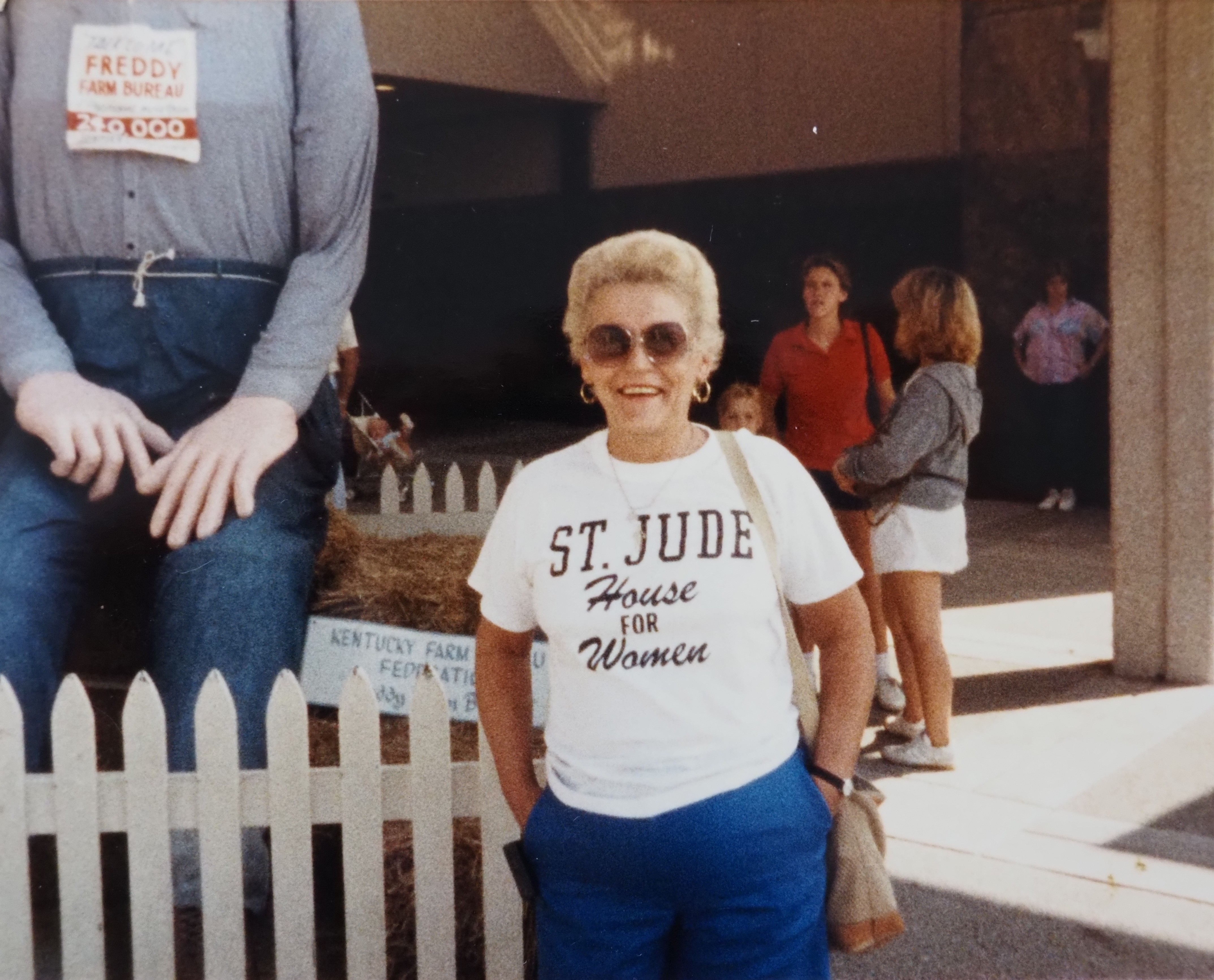
Bette Rentschler was known as “Mom.”
“Bette is St. Jude’s House,” Kathy said.
That quote is an excerpt from a Courier-Journal article on April 28, 1985, featuring Bette, who was the first resident manager at St. Jude House.
In April 1985, St. Jude House opened as a five-room shotgun house near the comer of St. Catherine and Clay streets. It’s fitting Bette ended up at St. Jude, who is the patron saint of hopeless causes.
Two years prior, Bette told the Courier Journal “there wasn't anyone more hopeless than me.” Her father was an alcoholic, and she followed suit. She also spent time in jail. She was married on three separate occasions and had four children. She had no financial literacy, and was a cook by profession.
“She had lost everything, including her children,” said Vince England, her son.
As a young adult, Bette wound up in institutions in Lexington and Cincinnati on about 40 separate occasions. She moved to Louisville with two changes of clothes and a $5 bill.
Shortly thereafter, Bette enrolled in a substance use program. She spent time at Talbot House, a men’s shelter on St. Catherine St. Its founder, Bill Wallace, helped Bette and thousands of alcoholics achieve sobriety. Bill was her Alcoholics Anonymous (AA) sponsor in 1981. She started on a “straight path.”
“Bill advised her that she had to give back,” England said. “He told her to be the house mother of ... St. Jude House. And that’s what she did.”
Vince, who hadn’t spoken with his mom in several years, only heard of her transformation because the Courier-Journal reporter who featured Bette mailed the article to him.
“She mailed this article with a letter saying to give your mother another look ... because of what St. Jude had done,” England added.
To England, this was shocking news to say the least, who only knew his mother as an alcoholic. He drove down himself to see things firsthand. He visited her at St. Jude House and attended an AA meeting that his mother facilitated.
“St. Jude was responsible for her life-change, where she found purpose,” he said. “My mother stayed sober for the rest of her life.”
The program served up to 12 women who had alcohol problems. It became the first halfway house in Louisville for women seeking a new life in recovery.
“She was a tough love type of person for the women,” England said. “Her devotion to helping women recover was foundational to her success in staying sober.”
In 2020, we ended this program and launched a new program that helps those experiencing homelessness due to fleeing domestic violence.
Last December, England drove from Plainfield, IL, to McCreary County in southeastern KY, for a mission trip with a Christian nonprofit. On the way, he dropped off a donation check to St. Vincent de Paul. He said it was “incredibly emotional at the time” to be on campus.
“Through St. Vincent de Paul ... she was given stepping stones to get out of her addiction and find purpose or self-worth. The greatest thing about St. Jude is it gave her a purpose … to help other women who were struggling with what she did. St. Jude provided her with everything for her future.”
Bette, who passed away 15 years ago, had a great relationship with England’s family, including her grandchildren.
This template controls the elements:
FOOTER: Footer Title, Footer Descriptions
CUSTOM MENU: Images and columns into header main menu submenu items
* This message is only visible in administrative mode
ST. VINCENT DE PAUL | LOUISVILLE
Send correspondence to
PO Box 17126
Louisville KY 40217-0126
Visit us at
1015-C South Preston Street
Louisville, KY 40203-2733
(502) 584-2480
Privacy | Terms | Refunds | Photo & Video
| Follow Us: |  |  |  |  |
|
|
 |